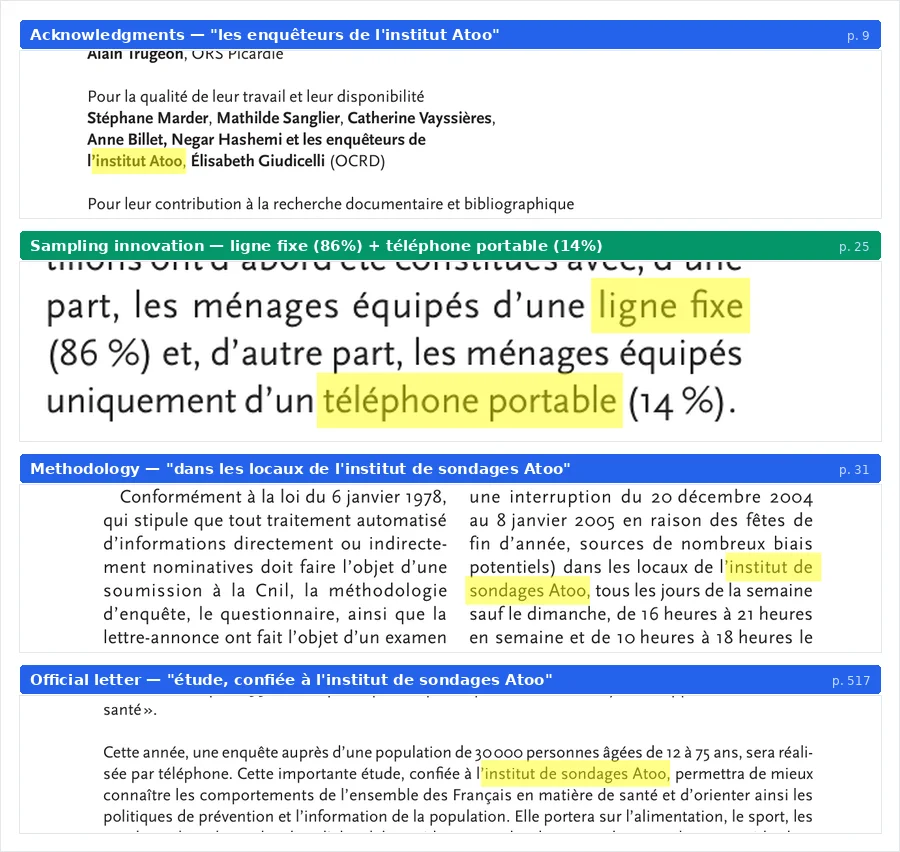
Study led by Denis Cohen, founder of Dropcontact, former head of Atoo Research Institute (French National Health Survey • 30,514 respondents • $11M government contract) | Updated: February 2026.
You're paying for emails that never get delivered.
It's not just a bad database. Most email validation tools used during enrichment flag catch-all domains as "risky" and silently discard them. The problem? Those domains belong to your highest-value targets: Fortune 500 companies, global tech leaders, and fast-growing startups. Without realizing it, you're literally filtering out your best leads.
And even when a tool does return an email, there's no guarantee it actually belongs to the person you were targeting (job change, company-to-domain mismatch…). You'll never know. All you see is conversion rates quietly declining month after month.
For your European prospects, there's an even bigger issue: compliance. Nearly all providers rely on third-party email validation services and stay silent on a critical point — your prospects' personal data is routed through servers outside the EU. That puts it squarely under regulations like FISA 702 and the Cloud Act, wiping out any GDPR compliance and your legal right to use those emails.
To cut through the noise, we put 15 leading Email Finders through the most rigorous real-world audit ever conducted: one single file, 20,000 real contacts, and a methodology that leaves zero room for guesswork.
The results were not what we expected.
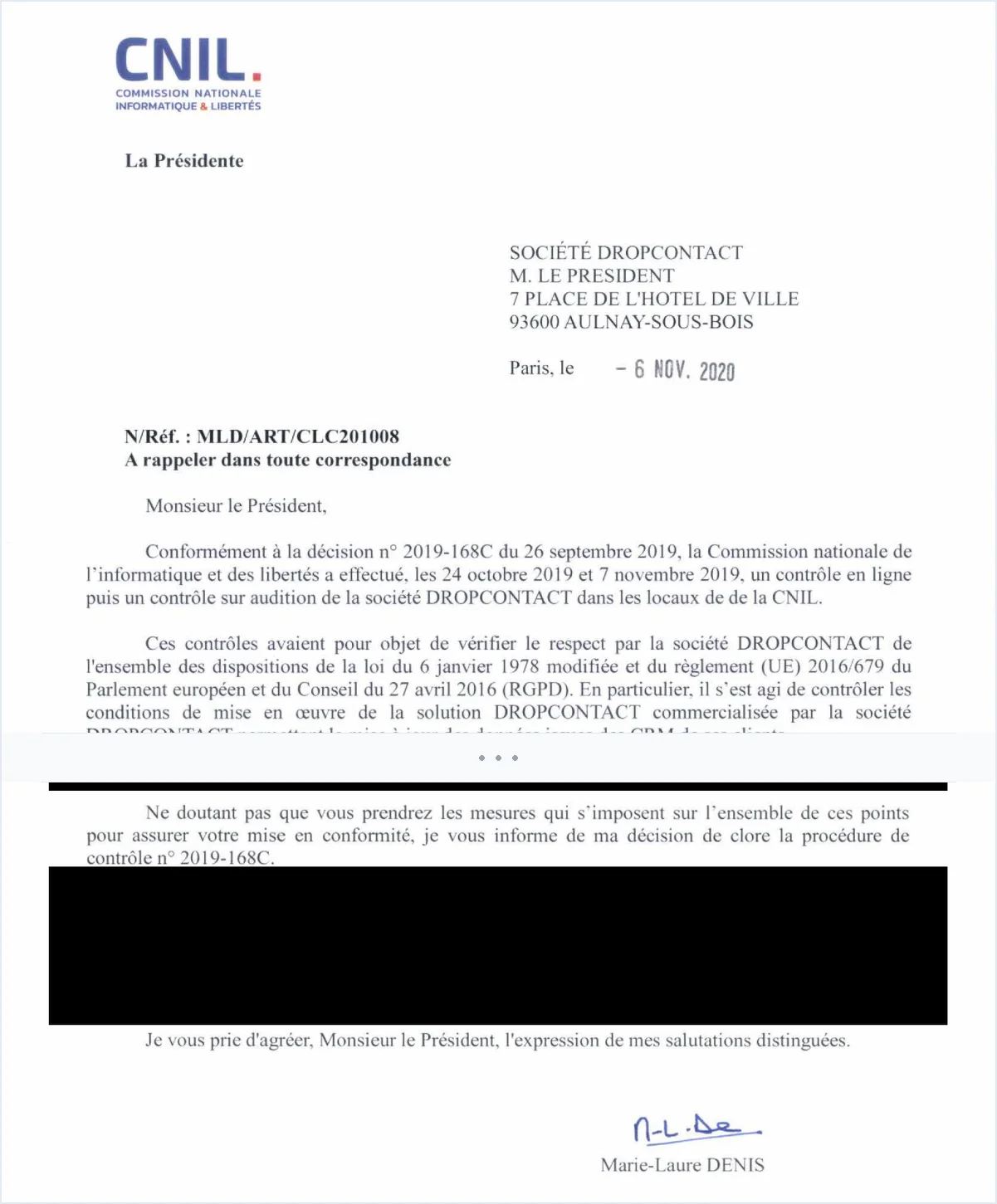
Transparency. This study was conducted and entirely funded by Dropcontact, the only email enrichment solution whose GDPR compliance has been audited in depth by the CNIL (France's data protection authority, widely regarded as the strictest in Europe), with direct access to databases, IT systems, and source code, and formal closure of the investigation signed by the President of the CNIL herself, Marie-Laure Denis (letter dated November 6, 2020, ref. MLD/ART/CLC201008).
The GDPR opt-out suppression list mechanism implemented by Dropcontact in 2018 was later adopted by the CNIL as an official recommendation (cnil.fr, January 27, 2022).
For application security, Dropcontact undergoes an annual Cloud Application Security Assessment (CASA) audit by the App Defense Alliance, based on the OWASP Application Security Verification Standard (ASVS) Tier 2. This audit covers 14 categories of security controls (authentication, access control, cryptography, data protection, API security, etc.) and is performed by an authorized third-party lab.
Dropcontact is one of the 15 tools tested and was subject to the exact same protocol as all others. Full methodology, limitations, and reproducibility: see below.
In this study:
Real rate = raw rate - hard bounces - wrong domains. See the full ranking of all 15 tools and detailed methodology below.
A single file of 20,000 real contacts, randomly sampled — not generated or fabricated. The data was used as-is, with all the imperfections found in real-world conditions: first and last names swapped, inconsistent capitalization, approximate company names. Geographic breakdown: 9,800 US contacts, 9,700 European contacts, 500 rest of world. Only three columns: first name, last name, company name. No website URL. No LinkedIn profile. Real data, real conditions — to measure each tool's actual performance.
The same file was submitted to each of the 15 tools, following each tool's own instructions. No manual intervention. Raw results were collected as-is. The protocol is fully reproducible: build your own file of 20,000 contacts, submit it to all 15 tools, send the emails found. The results will fall within the same range.
"The Truth is in the Methodology: No Simulations, No Shortcuts."
To get the truth, we didn't just run an algorithm or rely on simple 'pings.' We conducted a rigorous audit built on two verification pillars:
We didn't settle for status codes. We actually sent a real email to every single address found to confirm real-world deliverability. This is the only way to isolate actual hard bounces, while filtering out soft bounces and refuse bounces (caused by deliverability issues, test sending domain reputation, or anti-spam filters), which are false positives that other benchmarks mistakenly count as failures. No third-party validators, no simulations.
To ensure that the domain returned by each tool actually belongs to the correct company, we applied a dual-entry verification protocol. For each company, a first operator independently identified and entered the corresponding website based on the company name. A second operator then performed the same task separately, with no access to the first result. Both entries were then compared automatically. When they matched, the company-to-domain association was validated. When they diverged, the case was flagged for additional review and resolved using available sources.
This protocol detects domain identification errors, prevents confusion between similarly named companies, and ensures accuracy between the input company name and its actual domain. The final dataset was produced only after every single discrepancy had been resolved and compared against the domains provided by each of the 15 email finders tested on the 20,000-contact file.
Origin of the method. This dual-entry verification with automated consistency control is a well-established data quality methodology, originally developed in the 1950s for IBM keypunch card verification and recognized in survey research as the "double data entry" gold standard. Denis Cohen, then Head of the Interviewer Network (ancien Responsable du réseau enqueteurs) at Mediametrie (France's leading media audience measurement company), proposed applying this method to paper questionnaire data entry during R&D meetings with the scientific direction led by Philippe Tassi (ENSAE, elected member of the International Statistical Institute) in 1992. The method was subsequently adopted by Mediametrie.
All processing, from enrichment to validation to live sending, remained exclusively on EU-based servers. The test sending domains were rigorously configured, monitored to ensure they were never blacklisted, and methodically warmed up before any email was sent. No data left the European Union at any stage.
This level of manual precision combined with real-world email delivery testing is rarely, if ever, seen in published email finder benchmarks. It is the difference between a calculated guess and a verified result.
For each tool, four indicators:
The formula: Real rate = Raw rate - Hard bounces - Wrong domains
It would be reasonable to want access to the raw file of 20,000 contacts and the enrichment results from each tool. That's an understandable expectation.
The file contains personally identifiable data (first name, last name, professional email) as defined under Article 4 of the GDPR. Publishing this data, even for the sake of methodological transparency, would constitute processing without a legal basis. As a European company, Dropcontact is bound by the GDPR, including for data of contacts located outside the European Union.
Some vendors in this space publish or offer to share their dataset. That's their choice. But it's difficult to claim GDPR compliance on one hand, and publish a file of personally identifiable data on the other.
The verifiability of this study rests on the full publication of the protocol, not on the publication of the dataset. The test is reproducible.
Since 2023, the entire Email Finder and waterfall enrichment market has been built around two vanity metrics: the enrichment rate and the bounce rate. Every vendor optimizes for them, every comparison highlights them, every sales pitch leads with them.
This is one of the most consequential mistakes in the industry. The proof: reply rates have been declining year after year, forcing sales teams to build increasingly complex sending infrastructures just to push out ever-larger volumes of cold emails. More domains, more mailboxes, more warm-up tools — all to compensate for data quality no one is measuring correctly.
Across the 15 tools we tested, the gap between the advertised raw rate and the real usable rate ranges from 1.9% to 29.7%. Some solutions deliver nearly one-third of unusable emails.
When an Email Finder claims a "find rate of 80%" and a "bounce rate under 3%," it sounds impressive — but it tells you nothing about what's actually usable for outreach. That's the difference between a marketing number and an operational result.
A technically valid email sent to the wrong domain is worse than an email not found at all: it reaches a real inbox, but not your prospect's. Your reply rate collapses, and you don't understand why. The wrong domain rate ranges from 1% to 22.5% across tools. It's a metric that virtually no other benchmark even tracks. This study measures it for all 15 tools.
The vast majority of Email Finders, around 98%, on the market rely on pre-built databases, often purchased from the same third-party providers. This model has its logic: it's faster to set up, cheaper to operate, and it's been the industry standard for over a decade. Most vendors in this space were built on this architecture, and it worked well for a long time.
The core issue is that it doesn't age well. Annual turnover of professional email addresses sits between 25% and 33%. A database purchased in January loses a quarter of its value before December. And from a legal standpoint, storing and reselling personal data without the contact's consent creates a GDPR compliance issue the industry hasn't collectively resolved.
The price displayed on an Email Finder's pricing page doesn't reflect the true cost. When measured against genuinely usable emails (after subtracting hard bounces and wrong domains), the cost per 1,000 emails ranges from $9.50 to $52 across tools. A 5.5x factor between the cheapest and most expensive solution in real terms.
The math is straightforward. If your current tool shows a raw rate of 70% but generates 15% hard bounces and 8% wrong domains, your real rate is 47%. And your cost per 1,000 usable emails is 50% higher than what you think you're paying.
This is the market's blind spot, and this study is the first to document it.
Finding an email is one thing. Verifying it is another. And it's in the verification step that the most serious risk hides for companies whose targets operate in Europe.
Nearly all Email Finders on the market, including "waterfall" solutions, rely on third-party email validation services to confirm whether an address exists before delivering it. These validators are hosted on servers located in the United States (ZeroBounce, NeverBounce, MillionVerifier) or India (DeBounce).
In practice, your prospects' personal data (first name + last name + email = personal data under the GDPR) passes through servers subject to FISA 702 and the Cloud Act (USA) or with no adequacy decision from the European Commission (India).
The consequence is twofold: the enrichment solution loses its GDPR compliance, and so does the end-client company. Your company's DPO inherits the legal risk of the entire subprocessing chain.
Dropcontact is the only solution on the market that runs its own proprietary email validation algorithms, hosted exclusively on servers located within the European Union. No personal data transfer to any country outside the EU, at any stage of the enrichment or validation process.

"Self-Declared Compliant" vs. "Audited by the CNIL"
Nearly every Email Finder displays a GDPR badge or a compliance statement on its website. None has been audited by the regulatory authority.

In October and November 2019, the CNIL (Commission Nationale de l'Informatique et des Libertes, France's data protection authority, widely regarded as the most stringent in Europe) initiated a formal investigation of Dropcontact on its own authority (decision no. 2019-168C). The audit took two forms: an online inspection (October 24, 2019) and a full-day on-site hearing at the CNIL's headquarters (November 7, 2019).
The scope: "to verify compliance by the company DROPCONTACT with all provisions of the amended French Data Protection Act of January 6, 1978 and Regulation (EU) 2016/679 (GDPR)," and specifically "the conditions under which the DROPCONTACT solution is implemented for updating data from its clients' CRMs." The core business.
The CNIL's official summons (ref. ART/DI191278, registered letter with acknowledgment of receipt) reveals the depth of the audit. The CNIL required:
The audit team included a specialized legal expert and a systems auditor. Dropcontact opened its systems, databases, and code.
On November 6, 2020, the President of the CNIL herself, Marie-Laure Denis, notified Dropcontact of the formal closure of investigation no. 2019-168C. No sanction. No formal notice. Closure.
This is not a routine letter. The letterhead reads "The President." It is an act signed by France's highest authority on personal data protection.
The official letter from the President of the CNIL, widely considered one of the most demanding authorities in Europe on GDPR enforcement (partially redacted for confidentiality), is available below.
Discover the top 15 email finder tools compared side by side. See features, accuracy, and pricing to choose the best solution for your business.
As early as 2018, before the investigation even began, Dropcontact had implemented a "GDPR suppression list" mechanism: a permanent exclusion system for individuals who exercised their right to object, based on salted hashing (not simple MD5, which is far too vulnerable to attacks). This mechanism prevents any re-contact without storing personally identifiable data.
In 2019, the CNIL audited this method during its investigation, with access to the source code.
On January 27, 2022, the CNIL published an official recommendation describing exactly this method: "How to use a suppression list to comply with the right to object to commercial prospecting".
Dropcontact didn't follow the CNIL's recommendations. The CNIL turned Dropcontact's practice into a recommendation.
Since this study was conducted, Dropcontact's algorithms have integrated a capability exclusive to the market: email address enrichment based on double first names and double last names. This feature was not in production during the tests.
This is a particularly significant advantage for companies prospecting in Spain (Maria del Carmen Garcia Lopez), the Netherlands (Jan-Willem van der Berg), Portugal, Latin America, or any market where compound names are the norm, not the exception. Nearly all Email Finders on the market fail on these cases because their algorithms only handle a single first name and a single last name.
Dropcontact's algorithms are continuously improving. The results presented in this study are a floor, not a ceiling.
A "catch-all" domain is a domain configured to accept all emails, regardless of the address. It appears impossible to tell whether john.smith@company.com actually exists or whether the catch-all configuration simply accepts everything. This is one of the most complex problems in email validation.
What happened on February 13, 2026. Overnight, Google patched an endpoint in its Calendar API that some enrichment solutions were using to validate or invalidate catch-all emails on professional domains hosted on Google Workspace. The technique involved querying this endpoint to detect whether an email address was associated with an active Google account.
This is a technique Dropcontact had partially tested and occasionally used back in 2019. But our own algorithms have gone far beyond that since. Dropcontact now has a near-perfect (but still not perfect; transparency requires saying so) ability to validate or invalidate catch-all emails on Google Workspace and Microsoft 365 domains, without relying on any third-party endpoint that could be shut down overnight.
The consequences for the market. It's likely that Google's fix temporarily prevents some solutions that relied on this technique from continuing to validate catch-all emails on Google domains. These are serious players, and we have no doubt they will find alternatives in the coming weeks, months, or years. But this illustrates a structural point: any solution that depends on a third-party endpoint for a critical function is exposed to this type of disruption. This is why Dropcontact developed its own catch-all validation algorithms, independent of any third-party API.
A note for insiders. We're not talking here about the so-called "Smart Chips Contacts" method in Google Sheets, sometimes discussed in certain circles. This approach is not viable for professional use: it generates far too many false positives. All it takes is for an email address to have existed at some point, even if the person has been gone for five years and the address is no longer active, for this method to still consider it valid. That's not validation. That's noise.
As part of our 2025 Ultimate Email Finder & Enrichment Comparison involving 20,000 real-world tests, we evaluated Aeroleads’ database-powered enrichment for accuracy, data quality, and ROI across various B2B use cases.
Founded in 2015 in India (HQ Bangalore, with a probably registered address in San Jose, USA – 29 employees, according to their LinkedIn profile), Aeroleads positions itself as a 2025 Email Finder & enrichment solution. The platform primarily targets B2B professionals (freelancers, merchants, SMBs, enterprises) but also extends to B2C. Within our Ultimate Email Finder & Enrichment Comparison (20,000 real-world tests), Aeroleads was benchmarked for accuracy and scalability.
⚠️ A security vulnerability, still present as of September 2025, allows access to the entire database with minimal technical knowledge!
Aeroleads positions itself as a well-known email finder and enrichment solution, boasting one of the largest databases with over 750 million profiles. Yet, our 2025 Ultimate Benchmark of Email Finder & Enrichment Tools—based on 20,000 real-life tests—uncovered critical flaws in data quality.
The platform recorded a 15% hard bounce rate, ranking among the worst of the 15 tools tested. In practice, this makes a secondary email verification tool almost unavoidable—driving up costs and eating into overall ROI.
Even more concerning, we identified 14.7% mismatches between company names and email domains. These inconsistencies directly harm deliverability and response rates, as many contacts simply don’t match the real target audience.
The bottom line: Aeroleads’ scale doesn’t make up for its lack of reliability—cost efficiency and campaign performance take a major hit.
In conclusion, Aeroleads ranks below average in our 2025 Email Finder & Enrichment Benchmark—especially when it comes to accuracy, deliverability, and ROI—compared to the 14 other solutions we analyzed.
Within our 20,000-test comparative study, AnymailFinder was assessed for deliverability rates, reliability of its proprietary database, and return on investment in modern sales workflows.
Anymail Finder is a UK-based company founded in 2015 in London. According to its LinkedIn profile, the company operates with a small team of 2–10 employees.
In our 2025 Ultimate Email Finder & Enrichment Comparison, Anymail Finder was evaluated for scalability, enrichment performance, and overall reliability in B2B lead generation workflows.
These features position Anymail Finder as a versatile email enrichment tool for both business and consumer outreach.
Anymail Finder relies on an email database, although the total number of contacts available is not disclosed.
Data origin includes web scraping (LinkedIn, Crunchbase) and third-party services, with unclear data provenance. While the company claims GDPR compliance, transparency around explicit consent and lawful data sourcing remains limited.
Anymail Finder initially returned a high volume with 9,491 / 20,000 emails found.
However, a critical quality issue stands out: 25.4% of results were unusable, driven largely by a very high hard bounce rate of 15.8%.
⚠️ A 25.4% unusable rate is well below acceptable standards for enrichment quality, directly harming deliverability and domain reputation. To mitigate this, teams would need to add a third-party email verification step, which increases costs and lowers ROI in large-scale campaigns.
Overall, despite solid initial volume, the 25.4% unusable rate places Anymail Finder among the weakest for data quality in our 2025 Email Finder & Enrichment Comparison.
Our side-by-side benchmark examined BetterContact’s unique waterfall enrichment strategy, powered by internal databases, to see if it outperforms traditional single-source email finders.
BetterContact is a French company founded in 2023.
According to its LinkedIn profile, the company currently operates with a very small team of 4 employees.
Within our 2025 Ultimate Email Finder & Enrichment Comparison (20,000 real-world tests), BetterContact was analyzed for scalability, enrichment quality, and reliability in B2B lead generation workflows.
BetterContact positions itself as an email enrichment service that can be used for both business and consumer prospecting.
These accessibility options make BetterContact usable in common sales and marketing workflows, as benchmarked in our 20,000-test study.
BetterContact pricing is based on a pay-per-email-found model, offered only through monthly subscriptions.
In our 2025 benchmark, its pricing was positioned as follows:
This places BetterContact in the low-entry, high-scale cost model compared to other email finders.
BetterContact is based on an email waterfall approach, relying on around 20 third-party enrichment providers.
Because of the origin of these sources, the data comes from a mix of:
However, despite references to transparency from the various email enrichment solutions, the exact origin of the data remains limited.
BetterContact essentially automates the process and compilation of various email enrichment and validation services, but remains fully dependent on the quality and performance of its subcontractors.
These concerns directly impact trust in long-term enrichment quality.
BetterContact operates on a waterfall enrichment model, aggregating results from around 20 third-party providers.
This means that the quality of BetterContact’s output is entirely dependent on the quality of the solutions it integrates. If partner providers have weak or outdated datasets, the overall accuracy of BetterContact will decline accordingly.
In our 20,000-test benchmark, we observed an 11.2% unusable email rate, broken down into:
This highlights both the benefits and the risks of relying on a waterfall model: while coverage is expanded, data consistency and accuracy remain exposed to the weaknesses of its upstream sources.
Overall, BetterContact provides broad enrichment thanks to its waterfall model, but its heavy dependence on partner solutions and an 11.2% unusable rate make its results less reliable compared to the strongest performers in our 2025 Email Finder & Enrichment Comparison.
Even if BetterContact remains practical, offering integrations, automation, and accessibility, one key question emerges in 2025:
with the rise of Vibe Coding tools, AI enrichment, and workflow automation solutions like n8n, does BetterContact still have any real barrier to entry?
Its dependency on third-party providers and the lack of proprietary technology may limit its long-term differentiation in an increasingly competitive market.
In our comprehensive comparison, Datagma’s approach—relying on acquired and compiled external email databases from varied, undisclosed sources—was tested for accuracy, data freshness, and overall performance.
Datagma is a French company founded in 2021.
According to its LinkedIn profile, it currently has a very small team of only 2 employees.
Within our 2025 Ultimate Email Finder & Enrichment Comparison (20,000 tests), Datagma was evaluated for accuracy, freshness of data, and return on investment for B2B prospecting.
Datagma positions itself as an enrichment solution focused on professional B2B data discovery.
These features make Datagma accessible across different B2B workflows, but our benchmark showed that performance heavily depends on the underlying data sources.
Datagma pricing follows a pay-per-email-found model, available in monthly or annual subscriptions.
In our 2025 benchmark, the pricing tiers were as follows:
This pricing model appears accessible at first glance, but the real ROI depends heavily on the trustworthiness of the underlying data, which comes from undisclosed external sources of uncertain provenance.
Datagma indicates that its service relies on a mix of:
While Datagma advertises the use of real-time crawling, our analysis suggests that the actual enrichment relies primarily on pre-acquired external databases of undisclosed provenance. This raises serious compliance and reliability concerns, as the sourcing practices remain largely opaque.
These factors raise questions about Datagma’s reliability compared to more proprietary solutions.
Datagma’s data origins remain unclear, relying on acquired and compiled external datasets of undisclosed provenance.
In our 20,000-test benchmark, performance was heavily impacted by data quality issues.
A total of 23.5% of emails were unusable, broken down into:
⚠️ This high unusable rate raises legitimate questions about the reliability and compliance of Datagma’s enrichment process.
Overall, while Datagma offers results at a low nominal cost, the 23.5% unusable email rate significantly reduces its practical value and raises doubts about its effectiveness in large-scale B2B lead generation.
In our 20,000 real-world test benchmark, Dropcontact ranked first overall for both the quantity of valid emails found and the quality of enrichment data.
Its proprietary engine consistently delivered the highest accuracy and freshest results in the entire study.
Dropcontact is a French company founded in 2019 in Paris.
According to its LinkedIn profile, the company operates with a team of around 15 employees.
Within our 2025 Ultimate Email Finder & Enrichment Comparison, Dropcontact was analyzed for enrichment performance, scalability, and accuracy.
Dropcontact focuses exclusively on B2B enrichment, positioning itself as a solution for Sales teams, Marketing operations, and automation workflows.
👉 These powerful and high-performing integrations make Dropcontact directly usable within existing CRM and marketing workflows.
Dropcontact pricing follows a pay-per-email-found model, available with monthly or annual subscriptions.
In our benchmark, the plans are:
All pricing tiers include Dropcontact’s highly performant email validation system, with the exclusive ability to validate or invalidate catch-all domain addresses.
An additional option is available to automatically process and update changes in company information (such as job moves, new company domains, or role changes), ensuring that enriched data remains fresh and up to date.
This positions Dropcontact as a solution balancing scalability, cost-effectiveness, and advanced data reliability.
Unlike most competitors, Dropcontact has developed proprietary algorithms to generate and verify contact data in real time.
Its system is based on:
This approach ensures that enrichment quality and freshness are not dependent on third-party providers.
Dropcontact is an Email Finder powered by proprietary algorithmic technology, designed to deliver accurate and up-to-date professional contact data.
In our 20,000-test benchmark, Dropcontact consistently ranked among the most reliable solutions.
While some bounces were observed in earlier versions of the tool, even after double verification, the solution has since been improved and reinforced to further minimize this risk.
Unlike database-based solutions, Dropcontact’s real-time enrichment approach prevents the issue of data obsolescence and ensures information remains fresh.
This model also provides a key compliance advantage: it is fully aligned with GDPR regulations, which apply to individuals living in Europe and prohibit the resale of stored personal data without the explicit consent of the individual concerned.
By not depending on external providers or static datasets, Dropcontact distinguishes itself from 99% of solutions on the market, offering a unique approach to email enrichment.
Overall, Dropcontact achieved the highest balance of accuracy, freshness, and cost-efficiency in our 2025 Email Finder & Enrichment Comparison, confirming its position as the performance leader of the study.
We evaluated Enrow’s minimalistic enrichment approach as part of our 2025 Ultimate Email Finder & Enrichment Comparison to determine whether its streamlined design delivers consistent accuracy and value in real-world scenarios.
Enrow is a French company founded in 2023.
According to its LinkedIn profile, it currently operates with a very small team of 3 employees.
Within our 20,000-test benchmark, Enrow was analyzed for accuracy, scalability, and cost-effectiveness.
Enrow presents itself as a lightweight solution primarily designed for B2B use cases.
These accessibility options allow Enrow to be connected to automation workflows and integrated into sales or marketing operations.
Enrow pricing is based on a pay-per-email-found model, with monthly or annual subscription plans.
The tiers are:
Enrow is positioned as an affordable Email Finder with a streamlined design.
In our benchmark, it showed a total error rate of 8.1%, including 5.8% domain errors (emails reaching the wrong recipients) and 2.3% hard bounces.
During testing, we also identified some emails that appear to originate from pre-existing databases. While seemingly limited in scope, this raises legitimate questions about transparency and GDPR compliance.
Part of our Ultimate 2025 Email Finder Comparison, FindThatLead’s single-source database was tested for accuracy, compliance, and adaptability in B2B outreach.
FindThatLead is a Spanish company founded in 2014 in Barcelona.
According to their LinkedIn profile, they have 18 employees.
FindThatLead combines web scraping, simple pattern-based algorithms, and stored databases to find emails and enrich prospect data.
FindThatLead offers an attractive pricing model, especially with its unlimited plan at €99/month.
However, in our 20,000-contact benchmark, the results were among the weakest of all tested tools.
Only 18.4% of emails were initially found, and after validation, just 14.2% proved usable.
The high domain error rate (7.6%) and hard bounce rate (15.1%) combine into a total error rate of 22.7%, the highest of the entire study.
This positions FindThatLead as the least reliable solution in the 2025 comparison.
In our 20,000 real-world tests, we examined Findymail’s enrichment capabilities for accuracy, transparency, and scalability in lead generation workflows.
Findymail is a French company founded in 2022.
According to their LinkedIn profile, they currently have 9 employees.
Findymail is positioned as a developer-friendly solution, often integrated into automation workflows and lead generation pipelines.
Findymail does not disclose precise details about its enrichment process, making it unclear whether the platform relies on proprietary methods or external sources.
This lack of transparency makes it difficult to evaluate how results are generated and how data freshness is ensured.
Findymail provides a variety of tools for email lookup and integrations that are useful for lead generation workflows.
However, in our 20,000-contact benchmark, only 6,831 emails were usable, resulting in an actual enrichment rate of 39.9%.
Performance was further limited by an error rate of 6.2% (including both domain errors and hard bounces).
In addition, data sourcing methods are not disclosed, making it difficult to fully assess reliability, freshness, and GDPR compliance.
FullEnrich claims to leverage a cascade of over twenty different data sources for enrichment. In our 20,000 real-world test benchmark, we evaluated its accuracy, consistency, and overall performance against 14 competitors.
FullEnrich is a French company founded in 2024.
According to their LinkedIn profile, they have 15 employees.
FullEnrich markets itself as a scalable enrichment solution for sales and marketing operations.
FullEnrich operates through an email waterfall system, sequentially querying +20 partner providers until a result is found.
These partners include solutions such as Datagma, Wiza, Hunter, PeopleDataLabs, Clearbit, and others.
Like BetterContact, FullEnrich does not generate its own enrichment but rather connects to multiple third-party sources.
Its results are therefore entirely dependent on the quality and continuity of these external providers.
FullEnrich is a well-designed product, even receiving recognition on Product Hunt for its interface and positioning.
In our 20,000-contact benchmark, however, the loss of usable emails remained significant at 15.3%, highlighting issues with accuracy and reliability.
The email waterfall model introduces additional risks, since FullEnrich depends on the practices of its 20 partner providers.
If even one of these providers is not fully GDPR compliant, the entire waterfall process may lose compliance for European targets.
Some of the partner sources also appear to rely on public databases or less reliable methods, further affecting data quality.
Finally, while FullEnrich aggregates multiple providers into a single interface, the concept itself raises questions:
with the rise of vibe coding tools, automation platforms like n8n, and AI orchestration, does FullEnrich really maintain a strong barrier to entry in 2025?
We analyzed GetEmail’s database-driven enrichment engine to assess performance, coverage, and accuracy across different global markets.
GetEmail is a French company founded in 2016.
According to their LinkedIn profile, they have 20 employees.
GetEmail relies on real-time web scraping and pattern deduction.
The tool scans millions of websites to detect email formats (e.g., firstname@company.com) and then generates potential addresses for all employees at a given company.
This means that many results are not retrieved from an actual database but rather deduced, which can significantly affect accuracy.
GetEmail delivered a relatively strong raw enrichment rate of 48.4% in our benchmark, which initially positions it above several other solutions.
However, it also recorded the highest number of unusable emails across the entire study, with 3,077 incorrect addresses (27.1%).
This very high error level generates a direct financial overcost, since an external verification layer is almost mandatory to clean results before use. In addition, the hard bounce rate can progressively damage domain deliverability, reducing the chances of reaching inboxes over time.
Finally, because a significant number of generated addresses do not match the intended targets, cold email campaigns risk producing poor engagement and disappointing results.
Within our Ultimate Email Finder & Enrichment Benchmark, we evaluated GetProspect’s accuracy, pricing, and data sourcing strategies to assess its readiness for sales operations.
GetProspect is a Ukrainian company founded in 2016.
According to their LinkedIn profile, they have 6 employees.
GetProspect operates a large nominative database containing:
GetProspect delivered a relatively low enrichment rate in our benchmark compared to other solutions.
Out of the 20,000 tested searches, only 26.1% of emails were usable, reflecting one of the weakest scores in the study.
Additionally, 17.8% of results were unusable due to a mix of hard bounces and invalid domains, which undermines reliability.
This level of error not only reduces efficiency but also creates a risk of increased costs (through the need for additional verification) and weaker performance in cold outreach campaigns.
Hunter.io’s web scraping technology, combined with its structured datasets, was tested for deliverability, compliance, and cost-effectiveness across multiple geographies.
Hunter.io was founded in 2015 by two French entrepreneurs, and is often considered one of the pioneers of the Email Finder industry.
The company’s headquarters are now located in Delaware, USA.
According to their LinkedIn profile, they currently have 33 employees.
Hunter.io claims to operate a database of 117 million professional emails, continuously fed by scraping 90 million web pages per day.
It also uses email pattern deduction (e.g., firstname.lastname@company.com) to generate new contacts.
Hunter.io is one of the pioneers in the Email Finder industry, operating with a large database of 117+ million professional emails.
It is also one of the very few solutions in this benchmark to openly acknowledge its reliance on large-scale web scraping, whereas many competitors use similar practices without explicitly stating it.
In our benchmark, however, data quality issues emerged:
This led to a total of 5,570 usable emails out of 20,000 tested, limiting its reliability for sustained outreach.
Note: With the mass adoption of AI-driven scraping, it remains uncertain whether Hunter.io’s current approach will still be as reliable in the coming months or years.
That said, as a long-time pioneer in email enrichment with years of experience and domain expertise, Hunter.io is likely to continue refining its methods and adapting its strategy to stay competitive in the AI era.
We tested Icypeas’ enrichment approach to see whether its results align with or fall short of the accuracy levels observed in other solutions from our 2025 Ultimate Email Finder & Enrichment Comparison.
Icypeas is a French company founded in 2022.
According to their LinkedIn profile, they have 4 employees.
Unlike many competitors, Icypeas does not rely on pre-stored databases.
Instead, the platform works in real time by pinging open sources such as:
This method is designed to generate fresh results, but its effectiveness depends heavily on the availability and accuracy of these open signals.
Icypeas positions itself as an affordable Email Finder, delivering a usable enrichment rate of 31.6% in our benchmark.
Its real-time ping approach (web pages, SMTP, DNS) ensures data that is fresh and directly queried from open sources, but this method can lead to variability in coverage and consistency compared to database-driven competitors.
Overall, the results confirm that while emails provided are generally valid, the lower enrichment rate limits the volume of usable contacts for large-scale outreach campaigns.
LeadMagic was analyzed to assess its position in accuracy, coverage, and compliance within our 2025 Ultimate Email Finder & Enrichment Comparison.
LeadMagic is an American company founded in 2022.
According to their LinkedIn profile, they have 9 employees.
LeadMagic relies on a proprietary database, which is continuously enriched by combining multiple external and user-provided inputs.
This allows the platform to maintain a large nominative dataset that supports its email finder capabilities, but also raises questions about freshness and compliance.
LeadMagic showed an actual enrichment rate of 21.4% across 20,000 tested contacts.
Additionally, 4.2% of the collected emails were unusable, primarily due to hard bounces and invalid domains.
This error level generates a financial overcost, as a secondary verification process becomes highly recommended to secure campaign results.
It may also affect domain deliverability over time, while reducing the effectiveness of cold outreach campaigns if messages are sent to invalid or misattributed contacts.
We assessed VoilaNorbert’s simplicity and speed in our 20,000-test benchmark to determine its reliability for large-scale outreach campaigns.
VoilaNorbert was originally created in 2015 by two French entrepreneurs before being acquired by a U.S.-based company in Texas.
According to their LinkedIn profile, they have 12 employees.
VoilaNorbert provides emails through its proprietary internal database, primarily populated by:
VoilaNorbert showed an actual enrichment rate of 24.2% in our 20,000-test benchmark.
Among the results, 22.5% of the collected emails were unusable, mainly due to hard bounces and invalid domains.
This level of error can directly impact the effectiveness of cold outreach campaigns, as bounced or misattributed contacts reduce both deliverability and response potential.
Denis Cohen, Founder and CEO of Dropcontact
Denis Cohen founded the research and survey institute Atoo Research Institute (Atoo Etudes). After 3.5 years in operation, Atoo won a $11 million government contract through a competitive public tender with INPES (France's National Institute for Prevention and Health Education) to conduct a series of national public health studies.
The first of these studies, the 2005 National Health Barometer (Barometre Sante 2005), remains one of the most ambitious surveys ever conducted in France: 30,514 respondents surveyed, 192 interviewers, 47 expert researchers and statisticians mobilized (INSERM, INED, InVS, Penn State University, Universite du Quebec a Montreal), fieldwork monitored daily by an independent organization (OCRD). Results published by Editions INPES (ISBN 978-2-9161-9201-7).
This large-scale applied research experience is the foundation of this benchmark's methodological approach: published protocol, 20,000-contact sample (the largest in the industry worldwide), verification by actual sending, full reproducibility.
LinkedIn Denis Cohen - CEO Dropcontact
This study will be updated in S2 2026 based on email enrichment research on more than 50,000 contacts